

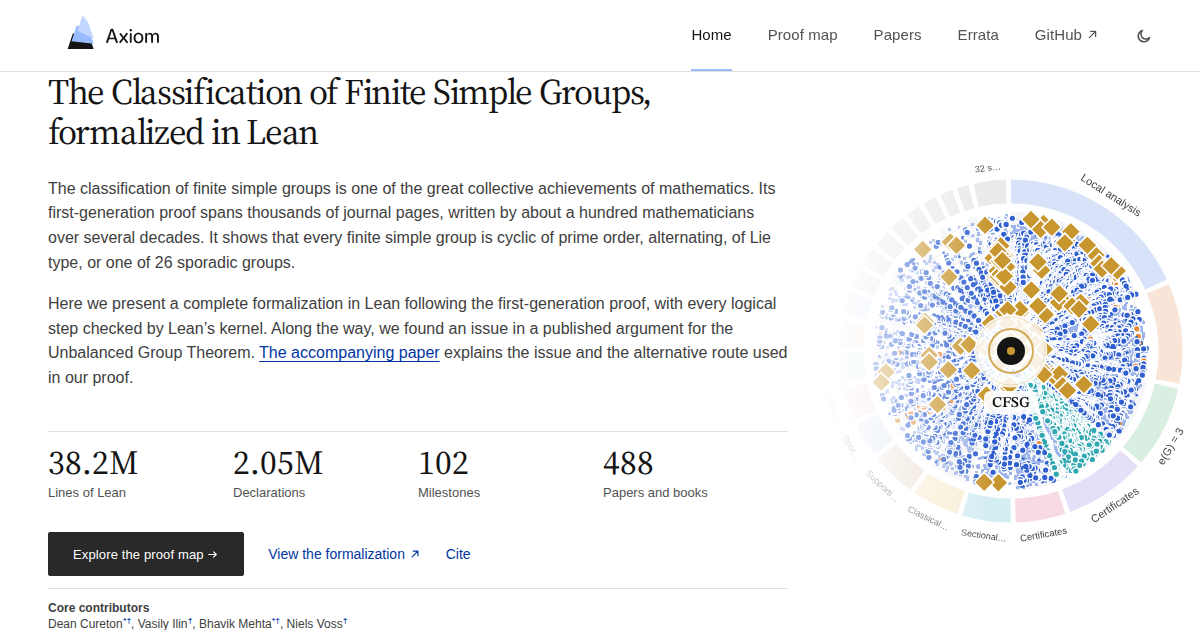
AI math company Axiom announced on Oct 27 that swarms of dozens of AI agents formalized the Classification of Finite Simple Groups (CFSG; the original proof runs about 15,000 pages across 500+ articles by about 100 mathematicians) in the Lean proof assistant in 24 days, producing about 43.1M lines of Lean and 2.05M declarations, with the repo public on GitHub. The work surfaced 34 noteworthy deviations from the published record, and AxiomProver produced a new alternative argument for the Unbalanced Group Theorem.
Key Takeaways
- ✓Per Axiom: 24 days and swarms of dozens of AI agents produced about 43.1M lines of Lean, 2.05M declarations and 100 milestones, drawing on 715 papers and books
- ✓The original CFSG proof spans about 15,000 pages in 500+ articles by about 100 mathematicians; this is the first time it has been fully computer-checked
- ✓Formalizing it exposed 34 noteworthy deviations from the literature, the biggest a closure assertion in Walter's 1986 Unbalanced Group Theorem argument, with explicit counterexamples such as PSL2(49)
- ✓AxiomProver produced an alternative argument built on Solomon's 1976 theory and proved a new theorem, "Preservation of simple tops", published on Hexagon (2610.00575)
- ✓Humans stayed essential: original CFSG group theorists including Richard Lyons and Ronald Solomon were consulted, and an errata list will be published with an advisory board
Key Decision Metrics at a Glance
Turn your technical choice into a development budget
Compare 40 dev plans & simulate token costs vs $20/mo subscriptions
Project Links & Resources
Direct AccessIn-Depth Technical Analysis
Background and pain points
The Classification of Finite Simple Groups (CFSG) is one of the great collective results of 20th-century mathematics: every finite simple group is cyclic of prime order, alternating, one of 16 families of Lie type, or one of 26 sporadic groups (the largest being the Monster). The original proof runs about 15,000 pages in 500+ articles by about 100 mathematicians, and no one could fully check it. On Oct 27 AI math company Axiom announced on X a complete Lean formalization of CFSG, alongside an official blog post (dated Oct 26) and the public GitHub repo AxiomMath/CFSG.
Architecture and mechanism
Per the blog, engineers and mathematicians directed swarms of dozens of AI agents for 24 days, rewriting the first-generation proof in Lean with every step checked by Lean's kernel. Because agents produced proofs faster than Lean could recheck them, the team built build caches distributed across workers and parallel checks, and moved expensive finite calculations into separately checkable certificates, which Axiom says sped up verification by orders of magnitude. When progress stalled, agents were assigned to split coarse milestones into precisely stated smaller theorems. The project also reuses about 1.2M lines from Qiuzhen-CFSG and builds on Mathlib.
Benchmarks and verification
This is not a benchmark result, and Axiom has not disclosed which models were used or the compute cost. The project page lists (vendor figures) about 43.1M lines of Lean, 2.05M declarations, 100 milestones and 715 papers and books. Some X posts cite 50M lines; the official figure is 43.1M. The work found 34 noteworthy deviations from the literature, and AxiomProver produced an alternative argument for the Unbalanced Group Theorem, including a new result, Theorem 2.3, in a paper on Hexagon.
Getting started
Browse the interactive proof map at cfsg.axiommath.ai and the Lean code in the GitHub repo; Axiom says the release identifies the final theorem and documents how to check it. Axiom also notes that Lean checks the deductions, but humans must still confirm the formal statement says what the theorem says. For agent builders, it is a real example of large agent swarms with machine-checkable feedback on a very long task, and its task splitting and shared build caching are worth studying.
Benchmark side-by-side against alternatives, or calculate monthly token cost vs subscription break-even.
Discussion & Comments
0Sign in to join the discussion
Connect with AI developers to exchange benchmark insights.